
EU’re on Your Own
This week, we discuss Europe's new security dynamic.

Tocqueville in Review: Insecurity of the Familiar
Europe considers a future without America.
Dear Reader,
This week marked a tonal shift in the discourse surrounding the prosecution of the war in Ukraine - specifically with regards to Europe’s role.
Since the failure of Ukraine’s counteroffensive in the summer of 2023, the general outlook on Ukraine’s prospects for pushing back the Russian line has been dimming. As international focus shifts to the Middle East, Western military and financial commitments to Ukraine are failing to produce the desired effect - namely, a Ukrainian victory.
The big story of the week is that someone finally said the quiet part out loud: Emmanuel Macron publicly suggested that NATO troops could hypothetically be deployed in the defense of Ukraine.
Leaders of other European powers handled the statement with, roughly, the same alarmed care one might take when disposing of nuclear waste. Both German Chancellor Scholz and Polish President Donald Tusk, as well as Nato itself, denied that there were any plans to send NATO troops to Ukraine. (Meanwhile in France, Macron’s Rogues Gallery contributed its usual helpless cacophony.)
These vociferous denials are somewhat undercut by other events - namely, leaked conversations concerning Germany supplying new weapons to Ukraine, the recent expansion of the North Atlantic security network to include Sweden, and as the bevy of bilateral security arrangements that Ukraine is signing with various North Atlantic powers, including Germany. Thus far, Washington has answered this call with deafening silence.
America’s lack of guarantees - or indeed, further financing, as Congress continues to prevaricate on a bill that would commit to additional aid funding for Ukraine - is conspicuous, and underlines the struggles that President Biden faces in shepherding a deeply divided country. Between the lack of renewed support for Ukraine, a population that is wary of foreign entanglements, and the prospect of a second Trump presidency on the horizon, leaders in Europe worry that America may not be interested in remaining a pillar of Europe’s collective defense… which in turn pushes those with a mind for European security to consider what it might look like without the US. Should the US fail to resolve its dysfunction, these voices will get progressively louder.
Europe is not entirely unprepared. The story of American abandonment is one that has been discussed in the media since 2018, and President Macron in particular has been very vocal in advocating a future for European security without the US.
Furthermore, the concern is a hypothetical one for the time being: Yes, the US has failed to renew its commitments to Ukraine, but it has thus far provided much of the financial assistance to Ukraine, as well as a majority of the weaponry. American voters may be ambivalent to Europe, and the issue may be increasingly maligned by Republican lawmakers - but that was also true of US support for the Allies during World War II.
It is optimistic to hope that the current moment of conservative isolationism won’t last - but it’s not too optimistic. As the pseudo-Churchillian aphorism goes: “You can always count on America to do the right thing… provided she has tried everything else.”
Shane McLorrain
Managing Editor
The Campaign Enters the Courts… And the Old Age Clinic
David A. Bell
As I predicted in an earlier post, the presidential campaign these past two weeks has largely moved into the courts. But it is also passing into another, more unusual arena: gerontological medicine.
Yes, in theory, an actual primary campaign is still taking place on the Republican side. Despite her losses to Donald Trump in Iowa and New Hampshire, Nikki Haley has refused to concede to the man who calls her “birdbrain” and “Nimbra” (a deliberate mangling of her birth name, Nimarata Nikki Randhawa). She has pinned her hopes on a strong performance in her home state of South Carolina’s February 24 Republican primary. According to the polls, she has picked up some support there over the last two weeks, moving from roughly 25% to 32%. Unfortunately for her, the same polls show Trump at over 65% in the state. Barring a very unexpected development, South Carolina will mark the burial of her campaign, and Trump’s coronation as the unchallenged Republican nominee. Haley is now desperately trying to portray Trump as erratic, confused and chaotic. But Republican voters have seen ample evidence of these qualities in Trump for many years now. If they haven’t turned against him yet, they are unlikely to do so now. Read more.
From Art Goldhammer’s Blog

The State of the European Union, a five part series
From Part I…
Having been charged by The Tocqueville Review with the task of contributing a reflection on the state of the European Union as a prelude to the European parliamentary elections, I thought I’d avail myself of this blog to offer a preview of my thoughts. Although I normally limit myself in this venue to remarks on French politics, I think it’s important to see France in the context of Europe, and the EU is always in the background of what I write, even though I generally comment on France’s internal tussles. Attempting to peer into the future is inherently a risky business, but on looking back at my last communion with the crystal ball, the results of which appeared in The Tocqueville Review in 2017, I find that my prognostications were on the whole not too bad, except for an uncharacteristic bout of optimism concerning the possible election of one Emmanuel Macron, which I saw as a possible corrective to the gloomy implications of the recent ascent of Donald Trump to the US presidency and the prior decision of the UK to exit the EU. Read more.
Part II | Part III | Part IV | Part V
From the Archives: New Lows in Old Alliances
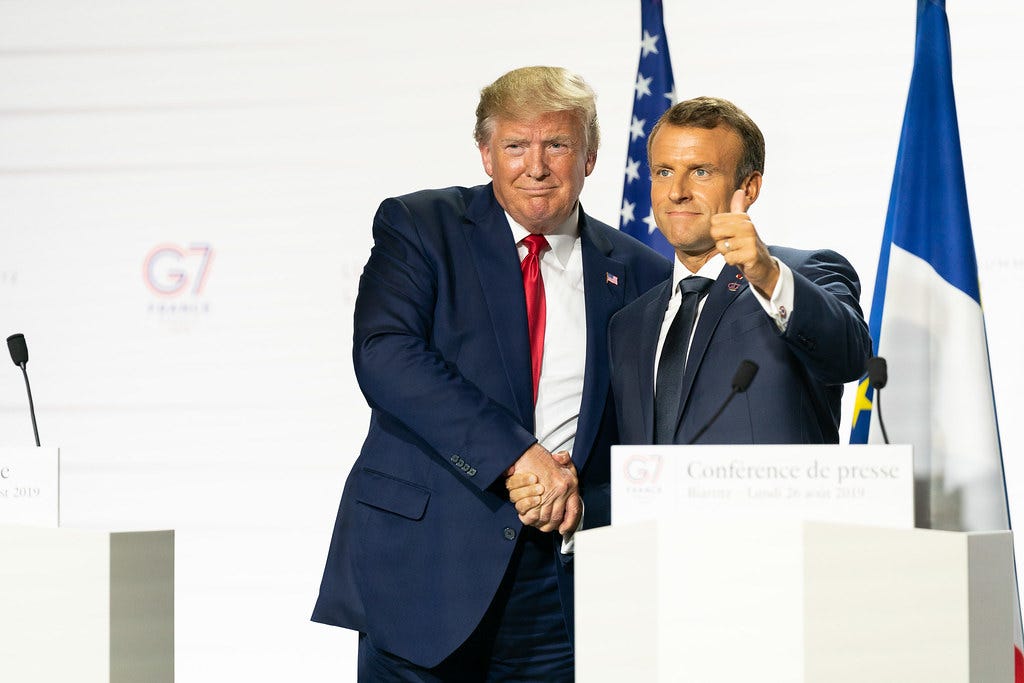
The American-led Western alliance has never seemed more fractured. Despite the threat of Russia on Europe’s eastern flank and tensions with China, Donald Trump’s ambivalence about NATO, and the Western led world order more generally, have provoked another round of discussions about ‘European Strategic Autonomy’, with Emmanuel Macron leading the charge. Three years ago our former Managing Editor Christopher Schaefer outlined why, despite all its complications and tumults, the relationship between the United States and France (and Europe) is probably here to say. Find the full piece here.